← Back to News
2026-03-23 18:59
MORE TARGETED TREATMENT FOR MULTIPLE SCLEROSIS
In multiple sclerosis the immune system damages tissue in the central nervous system. Many benefit from today’s drugs, but individualized treatment requires better knowledge of markers – such as those that predict aggressive or difficult-to-treat disease.
“Neuroimmunology attracted me because it combines the two complex fields of immunology and neurology. I’ve seen MS go from incurable to treatable,” he says.
But the knowledge has taken time to spread. Fredrik Piehl talks about a patient who had MRI brain scans carried out privately for several years, with MS-like changes in the brain having been observed for a decade. But it was only after a skiing accident that a diagnostic investigation was carried out.
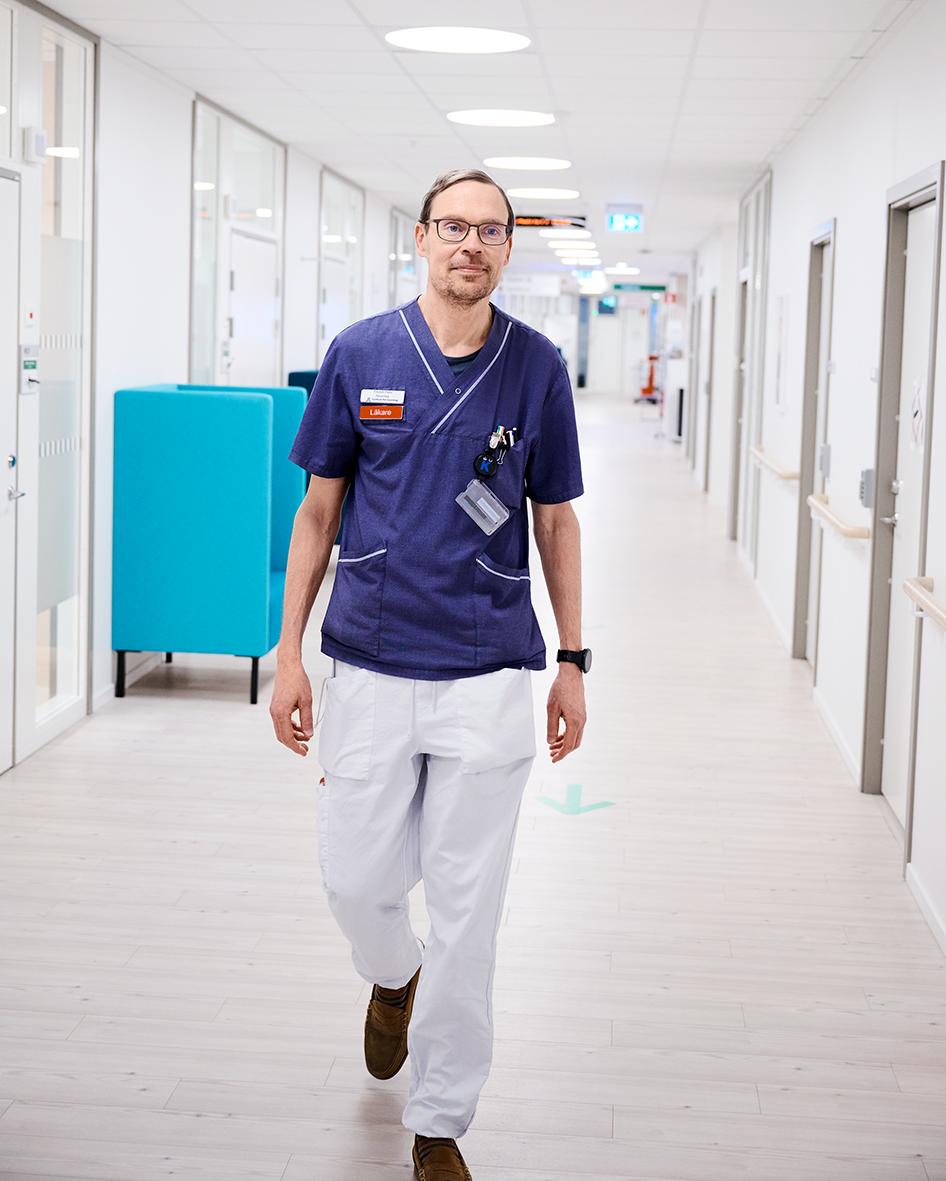
Fredrik Piehl, neurologist at the Centre for Neurology at Akademiskt specialistcentrum – Sweden’s largest clinic for patients with MS.
“When she came to me she was understandably frustrated that no-one had reacted to the changes, but the medical professional at the private clinic hadn’t thought it worth mentioning because nothing could be done anyway...”
Since interferon beta was approved 30 years ago, a number of immunosuppressive and symptom-relieving drugs have seen the light of day, including biologic drugs such as various antibodies.
Sweden stands out by primarily treating with the antibody rituximab. This knocks out the immune system’s B cells and the drug is approved for rheumatoid arthritis and cancer, but is used ‘off label’ in MS.
Fredrik Piehl and his colleagues have shown in several studies that rituximab has as good or better effect than today’s approved MS drugs. In a comparative study, for example, rituximab surpassed dimethyl fumarate, as published in Lancet Neurology in 2022.
“I’ve seen MS go from incurable to treatable.”
In 2016 Fredrik Piehl received a large US grant equivalent to SEK 86 million and the following year started CombatMS, a long-term research project aimed at characterising the course of the disease in MS. The study includes 4,100 Swedish MS patients.
“In several aspects it can be said to be the world’s best characterised MS cohort. In addition to neurological function assessment and self-reported scales, we also have access to MRI images, biomarker data from blood samples and spinal fluid, as well as genetic information for many of the participants,” he says.
Based on data from CombatMS the researchers could see that rituximab had a better effect than several comparable MS drugs, as published in Annals of Neurology in 2024.
“In addition, we save a billion kronor a year because rituximab is significantly cheaper. In 2023 the WHO began recommending rituximab for MS, making an effective and relatively inexpensive treatment available globally – a decision very much based on Swedish studies,” says Fredrik Piehl.
He highlights two current questions in the field of MS: what triggers the disease and what causes some people to suffer progressive illness?
The answer to the first question is that it seems to be an unfortunate mix of a particular viral infection and certain kinds of genetics, combined with hereditary and environmental risk factors.
“We know that you first need to be infected with the Epstein-Barr virus, which is best known for causing glandular fever. If you also have certain genetic factors, which includes the ‘wrong’ variant of the transplantation antigen HLA, MS can be triggered,” he says.
When infected, so-called helper T cells in the immune system detect what the HLA protein looks when combined with protein fragments from the virus. Other T cells, which are supposed to track down and kill intruders, then learn to recognise this as foreign to the body and the B cells in turn begin to form targeted antibodies. However, some HLA variants, particularly one called DRB15, increase the risk that the T cells and antibodies mistakenly damage the nerve cells’ axons and the myelin required for the nerve signals to proceed.